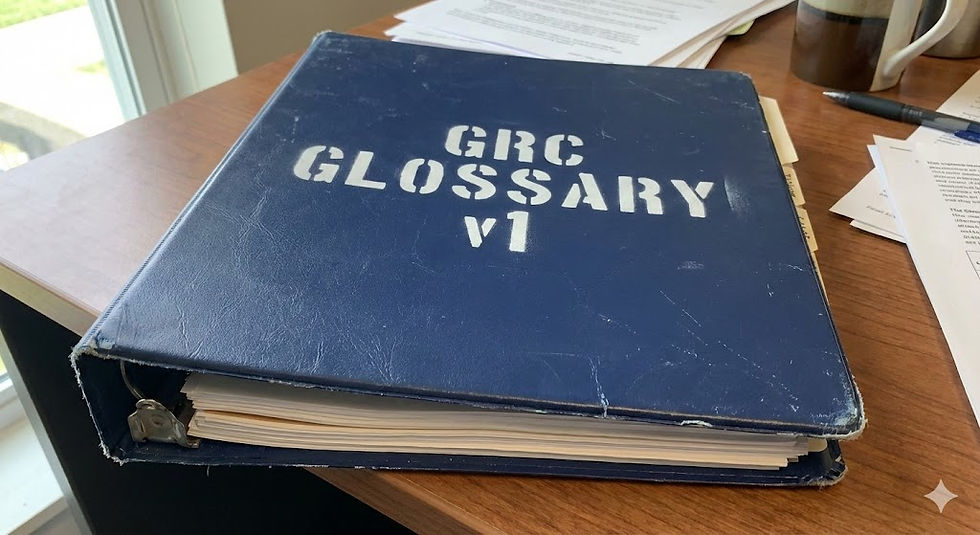
Plain-Language GRC Glossary v1

Governance – How decisions are made and who is responsible for what in an organization.
Risk – What could go wrong, how likely it is, and how bad it would be.
Compliance – Proving that you follow laws, regulations, contracts, and internal policies.
GRC (Governance, Risk & Compliance) – The combined practice of steering the business, managing risks, and meeting rules.
Control – Any policy, process, or technical measure used to reduce risk.
Control Objective – What a control is supposed to achieve (for example: “only authorized users can access this system”).
Risk Register – A structured list of risks, with impact, likelihood, owner, and status.
Risk Owner – The person responsible for understanding and managing a specific risk.
Control Owner – The person responsible for making sure a control exists and works properly.
Issue / Finding – A problem discovered during a review or audit that needs action.
Inherent Risk – The level of risk before any controls are applied.
Residual Risk – The level of risk left over after controls are applied.
Risk Appetite – The amount and type of risk leadership is willing to accept.
Risk Tolerance – The limits or thresholds of risk that are still acceptable.
Likelihood – How probable it is that a risk event will happen.
Impact – How serious the damage would be if the risk event happens.
Risk Rating – A combined view of likelihood and impact, often Low / Medium / High.
Risk Treatment – What you choose to do about a risk: accept, reduce, transfer, or avoid it.
Risk Acceptance – Choosing to live with a risk, usually with conscious approval.
Risk Mitigation – Taking steps to reduce the likelihood or impact of a risk.
Risk Transfer – Shifting part of the risk to another party, for example using insurance or contracts.
Risk Avoidance – Removing the activity that creates the risk.
Key Risk Indicator (KRI) – A metric that gives an early warning about rising risk.
Key Control – A control that is critical for keeping a major risk within acceptable limits.
Control Test – A check to confirm whether a control is designed and working as intended.
Control Design – How the control is set up on paper (policy, process, configuration).
Control Operating Effectiveness – How well the control works in real life.
Policy – A high-level rule or principle that guides decisions and behavior.
Standard – A more detailed requirement that supports a policy (for example: password length, encryption level).
Procedure – Step-by-step instructions for doing a task in a consistent way.
Guideline – Recommended good practice that is helpful but not strictly mandatory.
Exception – An approved deviation from a policy or standard, usually temporary and documented.
Attestation – A formal confirmation (often by signing or clicking) that something is true or has been done.
Audit – An independent review to check whether controls and processes meet defined criteria.
Internal Audit – An audit performed by the organization’s own audit team.
External Audit – An audit performed by an outside firm or assessor.
Assurance – Confidence provided by evidence that controls and processes are working.
Evidence – Documents, screenshots, logs or reports that prove a control is in place.
Segregation of Duties (SoD) – Splitting critical tasks so no single person can perform all steps alone.
Least Privilege – Giving people only the access they need to do their job, nothing more.
Access Control – How access to systems and data is granted, limited and removed.
Role-Based Access Control (RBAC) – Access based on roles (e.g., “HR analyst”, “System admin”) instead of individuals.
Joiner–Mover–Leaver Process – Formal steps to add, change, and remove user access when people join, change roles, or leave.
Information Asset – Data, systems, or services that have value to the organization.
Asset Owner – The person responsible for an information asset.
Data Classification – Grouping data based on sensitivity, such as Public, Internal, Confidential.
Confidentiality – Ensuring that information is not shared with unauthorized people.
Integrity – Ensuring that information is accurate and not changed improperly.
Availability – Ensuring that information and systems are accessible when needed.
CIA Triad – The three core security principles: Confidentiality, Integrity, Availability.
Information Security Management System (ISMS) – A structured system of policies, processes and controls to manage information security.
ISO/IEC 27001 – An international standard for building and operating an ISMS.
Annex A (ISO 27001) – The list of security controls suggested by ISO 27001.
Scope (ISMS) – The boundaries of what is included in the ISMS.
Statement of Applicability (SoA) – A document listing which Annex A controls are applied or not, and why.
Management Review (ISMS) – Regular leadership meetings to review the health of the ISMS.
Corrective Action – A step taken to fix the cause of a non-conformity so it doesn’t happen again.
Non-Conformity – A situation where a requirement (policy, standard, ISO clause) is not being met.
Continuous Improvement – Ongoing effort to make processes and controls better over time.
Information Security Policy – The top-level policy that sets the organization’s security direction.
SOC 2 – A framework and report type for assessing service organizations’ controls over security, availability, confidentiality, processing integrity and privacy.
PCI DSS – A security standard for organizations that store, process or transmit payment card data.
NIST Cybersecurity Framework (CSF) – A framework that organizes security activities into Identify, Protect, Detect, Respond, and Recover.
NIST SP 800-53 – A large catalog of security and privacy controls, often used in the public sector.
CIS Controls – A prioritized set of security best practices published by the Center for Internet Security.
GDPR – The EU’s General Data Protection Regulation, focused on personal data protection and privacy.
PIPEDA – Canada’s federal privacy law for private-sector organizations.
Data Subject – A person whose personal data is being collected or processed.
Data Controller – The party that decides why and how personal data is processed.
Data Processor – The party that processes personal data on behalf of a controller.
Privacy Impact Assessment (PIA) – A review to understand privacy risks in a system or project.
Data Protection Impact Assessment (DPIA) – A deeper assessment required in some laws when privacy risks are high.
Data Breach – A security incident that leads to loss, theft, or unauthorized access to data.
Incident – An event that harms or could harm confidentiality, integrity, or availability.
Incident Response Plan – The documented approach for detecting, responding to and learning from incidents.
Business Continuity – How the organization keeps critical services running during a disruption.
Disaster Recovery (DR) – How IT systems and data are restored after a major outage or disaster.
Recovery Time Objective (RTO) – The target time to restore a system or process after a disruption.
Recovery Point Objective (RPO) – How much data loss (in time) is acceptable, e.g., “we can lose at most 1 hour of data”.
Business Impact Analysis (BIA) – A study to understand how much different processes matter and what happens if they are down.
Third-Party Risk Management (TPRM) – Managing risk from vendors, partners and suppliers.
Vendor Due Diligence – Checks performed on a vendor before or during the relationship (questionnaires, documents, references).
Service Level Agreement (SLA) – A contract term that defines expected service levels and penalties.
Data Processing Agreement (DPA) – A contract that sets rules for handling personal data between controller and processor.
Sub-processor – A vendor used by your vendor to help deliver the service.
Onboarding (Vendor) – The process of approving and setting up a new vendor.
Offboarding (Vendor) – The process of safely ending the relationship and revoking access.
Critical Vendor – A vendor whose failure would seriously impact operations or compliance.
Vendor Inventory – A list of all vendors with key details like service, owner and risk level.
Vendor Tiering – Grouping vendors by risk or importance, such as Critical, High, Medium, Low.
Line 1 (First Line of Defense) – Business and operations teams that own and manage risks day to day.
Line 2 (Second Line of Defense) – Risk, compliance and security functions that oversee and guide Line 1.
Line 3 (Third Line of Defense) – Internal audit, providing independent assurance over Lines 1 and 2.
Governance Committee – A group (often including senior leaders) that reviews risks, issues and major decisions.
Charter (Committee or Program) – A document that explains purpose, scope, roles and responsibilities for a committee or program.
Register (Log) – A structured list, such as a risk register, issue log or vendor inventory.
Dashboard – A visual summary of key metrics, risks and control statuses.
Metric / KPI – A measurement used to track performance or progress.
Exception Register – A list of approved policy or control exceptions, with owners and expiry dates.
Audit Trail – A record of who did what and when, used for accountability and investigation.


Comments